
Last updated 17.09.2026
Non-invasive prenatal testing (NIPT)
There are various techniques used for determining the chromosomal makeup of a foetus, but the only diagnostic test currently available involves karyotyping, which is done by means of an invasive procedure such as an amniotic fluid test. NIPT is very effective for determining the risk that a foetus will be born with certain genetic abnormalities and has become widely used in recent years. Your doctor will be able to explain the different options available to you for screening for foetal chromosomal abnormalities. The team at the National Centre of Genetics, which is part of the LNS, is able to accompany patients throughout the process, from the moment blood is taken through to when any further testing is done or you attend a genetic consultation at our centre. You should remember that the decision to have this screening test done is very personal to each individual or couple.

What is NIPT?
Non-Invasive Prenatal Testing (NIPT) is a screening test for fetal chromosomal abnormalities performed using a simple blood sample from a pregnant patient. The test is based on the analysis of cell-free fetal DNA circulating in the maternal blood. It is a highly reliable screening test and poses no risk to the fetus.
The most common chromosomal abnormalities include trisomy 21 (Down syndrome), trisomy 18 (Edwards syndrome), and trisomy 13 (Patau syndrome).
What is a trisomy?
Each cell in the body has DNA, which contains all of a person’s genetic information. This information is organised into 23 pairs of chromosomes: 22 autosome pairs (1 to 22) and two sex chromosomes, namely XX or XY.
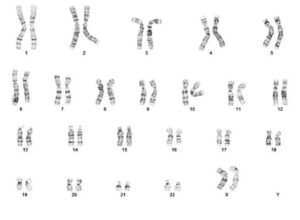
Female karyotype 46,XX
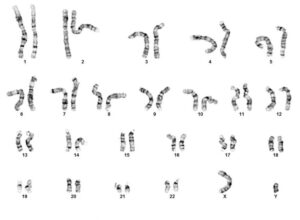
Male karyotype 46,XY
A trisomy refers to the presence of 3 copies of a chromosome, instead of two.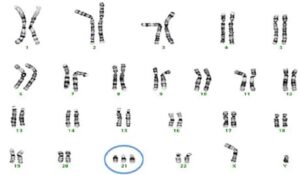
Karyotype showing trisomy 21 : 47,XY,+21
How does non-invasive prenatal testing work?
During pregnancy, fragments of foetal DNA from the placenta (cytotrophoblast) enter the mother’s bloodstream. These fragments are free-floating and not within cells, and are called cell-free foetal DNA (cffDNA). Through a simple blood test done at a laboratory, the fragments of cffDNA are counted to look for the presence of an extra chromosome 21, 13 or 18. This avoids invasive testing (such as an amniotic fluid test), which carries a greater risk for the foetus and results in miscarriages in 0.1-0.3% of patients.
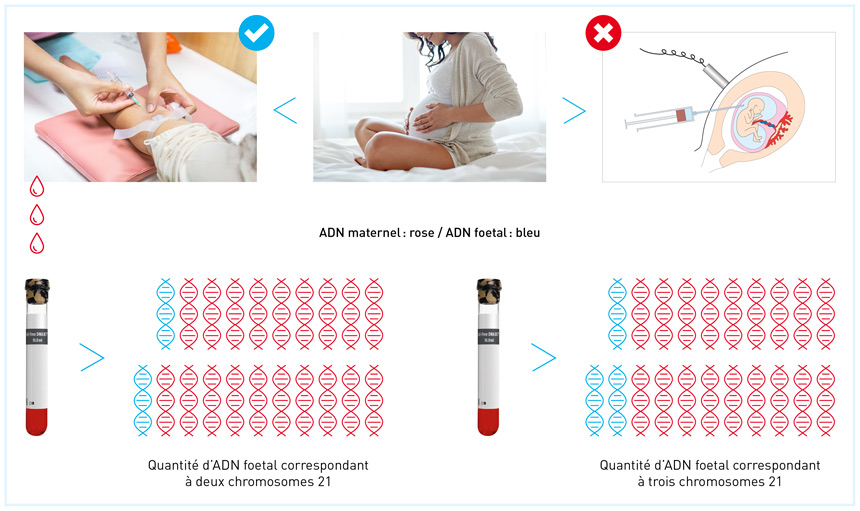
The method used to count cffDNA is high-throughput sequencing. The technique offered by National Center of Genetics is a whole-genome approach using the NIPT Veriseq Solution V2 developed by Illumina® ; CE-IVD certified.
Sequencing is more extensive and not limited to the chromosomes of interest. This technique also allows number abnormalities of chromosomes 13, 18 and 21 to be detected. It is used for twins or where there is a low volume of cffDNA in the mother’s blood.
In very rare cases, this whole-genome sequencing technique can detect other chromosomal anomalies (other trisomies, large duplication or deletion > 7Mb in size, or exceptionally chromosomal anomaly from maternal origin)
When is NIPT recommended?
This screening test is requested for pregnant women by physician in charge of monitoring their pregnancy, based on their medical history, and may be done from 12 weeks gestation (10th week of pregnancy) onwards.
It is not suitable for investigating abnormalities revealed on ultrasound scans, particularly nuchal translucency of > 3.5mm in the first trimester. In practice, this test should be done following the 1st trimester scan. Before it is performed, a specific form must be filled out by the doctor requesting the test and the patient, which must be sent to the Laboratoire national de santé along with a blood sample.
Pricing and Payment / Reimbursement Terms
There are two situations depending on the patient’s affiliation with the CNS:
1. Patients affiliated with the CNS
The NIPT test is fully covered by the CNS.
Affiliated patients do not receive any invoice, as the coverage is handled directly between the LNS and the CNS.
The applied rate, set at €606.80, is determined and updated annually by the CNS.2. Patients not affiliated with the CNS
Patients who are not eligible for CNS reimbursement will receive an invoice directly issued by the LNS.
The test fee is €606.80, the same for all patients, whether affiliated or not.
Non-affiliated patients must then submit a reimbursement request to their own insurance provider.When should NIPT be done?
NIPT may be done from 10 weeks gestation onwards, but ideally should be done from 12 weeks gestation, following the 1st scan. However, it may be recommended throughout the pregnancy. This test does not require fasting beforehand and you may have the blood taken at your normal laboratory. However, you can also have it taken at the LNS.
Who performs this analysis?
All stages of the test are carried out by the team at the National Center of Genetics (the Cytogenetics team, in collaboration with the Molecular Biology, Bioinformatics and Sequencing platforms). The team comprises specialized and experienced technical, administrative and medical staff with expertise in prenatal cytogenetics.
How long will I have to wait for my results and how will I get them?
Results are sent solely to the doctor who requested the test 7 to 10 days after the LNS receives your blood sample. They are never sent directly to the patient.
In the event of a:
Positive result
This means there is a high probability that the fetus has trisomy 21, 13 or 18. Nevertheless, NIPT is a screening test and the relevant professional bodies recommend having a positive NIPT result confirmed by way of an invasive diagnostic test (primarily an amniotic fluid test). Your gynaecologist will talk you through the results and next steps.
The cytogenetics team will analyze the sample of amniotic fluid taken and interpret the results. You may also be asked to attend a genetic consultation with our team.
In very rare cases, NIPT can detect other chromosomal anomalies (other trisomies, large duplication or deletion > 7Mb in size, or exceptionally chromosomal anomaly from maternal origin). Only chromosomal anomaly of medical interest for the ongoing pregnancy would be reported.
In case of detection of a rare chromosomal anomaly, medical genetic consultation is required to explain in details the anomaly, potential effects for the fetus (or for you), and need of further investigations.
Negative result:
This means that the probability of the fetus having trisomy 21, 13 or 18 is very low. In this case, your pregnancy will be monitored as planned.
Inconclusive result:
This means that it is not possible to reliably determine if the fetus has trisomy 13, 18 or 21. Inconclusive results are rare (around 1% of cases), but may occur for example when there is not enough cell-free fetal DNA (cffDNA) circulating in the blood sample taken from the mother. The proportion of cffDNA in the mother’s blood is known as the fetal fraction and is determined by many factors, including her BMI, if she is taking certain blood thinners, etc. Depending on your medical history, your gynaecologist may recommend you repeat the test or have further tests done.
Under no circumstances does having NIPT mean you do not have to go to your prenatal scans or attend check-ups with your obstetrician. This test is not a substitute for having your 1st trimester scan.
Is NIPT reliable?
The NIPT performed by the LNS is very reliable in terms of sensitivity and specificity.
The sensitivity is over 99% for detection of the most common anomalies, trisomy 13 , 18 and 21.
For more rare anomalies, the sensitivity ranges from 74 to 96%
– 96% for rare autosomal trisomies
– 74% for gain or loss of chromosomal >7 Mb (data Illumina®)NIPT remains therefore a screening test and cannot exclude at 100% presence of fetal chromosomal anomaly even in case of normal result.
Predictive positive value, meaning probability that the fetus is truly affected if the NIPT result is abnormal, is :
– 93% for trisomy 21
– 80% for trisomy 18
– 50% for trisomy 13
– 15-20% for rare chromosomal anomalies. (data : National Center of Genetics)NIPT analyzes cell free circulating DNA from placental origin. In some cases, the anomaly detected can be limited to the placenta without affecting the fetus. This phenomenon is known for every kind of chromosomal anomaly but more frequent for rare anomalies.
That’s why in case of abnormal NIPT result, a confirmation should be done on an invasive testing (preferably amniocentesis).
What are the limits of NIPT?
The non-invasive prenatal testing is a screening test for abnormalities in chromosomes. NIPT is unable to detect polyploidies (such as triploidy), balanced chromosomal rearrangements (exchanges of chromosomal fragments without any loss or gain of material), microdeletion/microduplication syndromes, or point mutation leading to monogenic disorders.
Any other questions about the NIPT test?
For all queries relating to NIPT, please get in touch with the constitutional cytogenetics team at the National Center of Genetics.
Tel. : +352 28100 549 (Monday-Friday, 09.00-12.00 and 13.00-17.00)
Fax : +352 28100 542
Email : ncg-cytogen@lns.etat.lu